Illegal drug trade
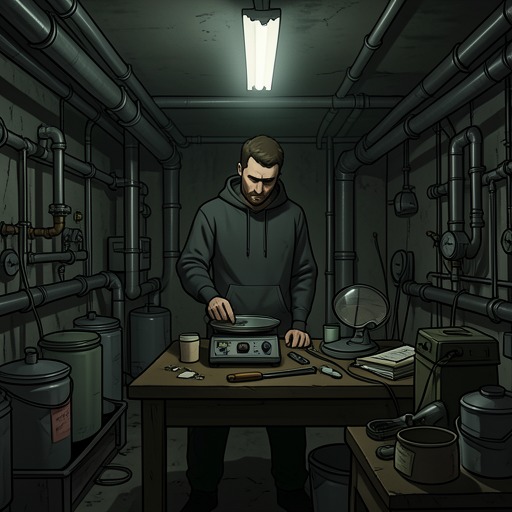
The Short and Tragic Life of Robert PeaceIllegal drug trade is one of the book’s central systems of exchange, risk, and identity. It begins as a small-scale marijuana economy around Robert Peace and expands into a network involving suppliers, couriers, friends, family expenses, and the basement of a Smith Street house. The trade offers Robert an immediate way to be useful and authoritative, but it also binds him to unstable men, escalating danger, and a public label that eventually reduces a Yale scientist and mentor to a “drug-dealing character.” Its importance lies in that contradiction: Robert does not experience the business as simple greed, yet the obligations he attaches to it repeatedly draw him toward violence and concealment.
Early Entry and Social Currency
Robert’s first role in the trade was shaped by reputation rather than formal ambition. After a school trip during which he and Curtis drank, smoked marijuana, laughed, and returned to win a junior-varsity game, classmates began approaching him in the hallway to ask whether they could buy weed. Robert refused to sell directly and sent them to Tavarus, who could obtain larger quantities through his older brother. Even so, Tavarus later slipped Robert a twenty-dollar bill and called it a kickback. Robert changed the money at a store on the way home and left half for Jackie Peace, as he habitually did. The exchange established an enduring pattern: illegal income was folded into family support, while access itself became a form of influence.
The trade also gave Robert a new standing among his peers. He became the person who could “hook you up,” even when he did not personally handle the transaction. That status resembled the authority he sought elsewhere, as a swimmer, student, coach, friend, and provider. The marijuana economy therefore entered the story not as an isolated criminal identity but as one more arena in which Robert could demonstrate competence, generosity, and command.
Yale, Humiliation, and the Newark Divide
At Yale, marijuana dealing operated alongside Robert’s academic and social life. He worked five nights a week in a dining hall, where a group of wealthy crew-team students left dirty trays and a crumby, puddled table for him to clean. They treated him as a service worker and apparently did not realize that he was also a student. The encounter provoked an anger far greater than the immediate insult seemed to warrant. Robert imagined punishing the men through “curbing,” then put his fist through the dishroom wall, swelling three knuckles. His friend recognized that the rage arose from a deeper conflict over class, race, dignity, and the unequal rules separating Newark from Yale.
The contrast between the dining hall and the marijuana market is revealing. In the dining hall Robert was visibly subordinated, wearing a starched uniform and hairnet while privileged students ignored him. In the drug economy, buyers came to him, he set terms, and his knowledge of local networks gave him leverage. His anger at Yale’s social order thus coexisted with his ability to profit from its demand. The trade became one of the ways he crossed the Newark–Yale divide while also preserving a resistant identity within it.
His Elihu biography made the underlying logic explicit. Robert described his mother’s sacrifices, the Pierson Street fire, the apartment on Chestnut Street, prison visits, the trial of Skeet Douglas, and his continuing effort to free his father. He presented the case as part of a system designed to suppress ordinary Black men. Arthur Turpin, who sensed the anger beneath Robert’s grin, laughter, and marijuana use, believed that Robert’s roots had become a source of self-limitation. The drug trade belonged to that unresolved inheritance: it was both a means of autonomy and another structure in which Robert remained exposed to the assumptions, dangers, and injuries of his neighborhood.
Networks, Transactions, and Obligations
The business was liquid and transient. Robert’s original connection, introduced by Flowy, disappeared, probably to avoid conflict with rivals, police, or both. A later supply route ran through Carl, whom Robert treated as an uncle and who demanded to be present during every purchase. Robert drove Carl to a supplier’s house in Ivy Hill, smelled the marijuana to test its quality, and negotiated the price down to $1,800 per pound, at the low end of the market. After each transaction he drove Carl home and left him $200. The arrangement was economically inefficient and personally risky, but Robert continued it despite criticism from Flowy, Tavarus, and Drew because the trade was also governed by kinship, loyalty, and reciprocal obligation.
The transactions required constant performance. Robert had to appear relaxed but tough, willing to walk away but not too willing, profane without becoming openly threatening, and imposing without provoking a dangerous supplier. This was the work of “fronting”: maintaining a social identity that kept buyers and sellers moving through the network. The contradictions were not accidental. A dealer needed to seem dependable and dangerous, generous and difficult to exploit, socially connected yet sufficiently detached to survive betrayal.
Robert’s friends remained central to this economy even when they were not all direct participants. He gave money to people who needed rent or children’s clothing, drove friends whose cars had broken down, and showed up when someone wanted company. Flowy drove an hour each way to help him replace a blown tire on the Merritt Parkway. Drew intimidated tenants into paying rent. Curtis, Tavarus, Drew, and Flowy later invested in Robert’s larger operation. These acts made the drug business resemble a system of informal welfare and mutual aid, but they also made withdrawal difficult. Robert’s identity as the Man depended on continuing to provide.
Violence, Withdrawal, and Return
The danger of the trade became unmistakable in August 2003, when a bulk supplier pulled a revolver on Robert after Robert threatened to abandon a failed negotiation. Robert claimed that he did not know whether the gun was loaded and later said he believed the supplier did not intend to fire, but the weapon reduced his world to the muzzle of a revolver. The knowledge he possessed as a scientist, along with the achievements of his life, offered no protection in that moment. He paid the additional couple hundred dollars demanded of him, then began teaching at St. Benedict’s and left the business.
The withdrawal was a genuine turning point, but not a clean break. Robert concluded that hustling had cost more anxiety than it returned in cash. At Yale, classmates had approached him and paid his price; in Newark, he drove dangerous streets at night to bargain over five- and ten-dollar amounts with desperate buyers. The work exposed him not only to suppliers and dealers but also to users whose lives were organized around the same commerce. Its “wear and tear” made the trade less like effortless entrepreneurship than a continuous encounter with instability, need, and threat.
After Skeet Douglas died, Robert redirected his ambition toward Peace Realty. By the beginning of the 2006–07 school year, he had renovated the Greenwood Avenue house, lived with Jackie on Chapman Street, and rented all three Greenwood units for a fluctuating profit of about $1,000 a month. Real estate appealed to him because it promised a legal and constructive version of the same entrepreneurial skills: finding undervalued property, negotiating with people across class lines, renovating, and creating shelter and security. Yet the desire to provide did not eliminate the attraction of illegal income. Robert continued to imagine success as something that could support family, friends, and former classmates, regardless of whether the money came through property or marijuana.
Expansion and Fatal Exposure
By the period of the Smith Street operation, Robert had recruited four young men between eighteen and twenty-two. He paid each $400 a week, gas money, and commissions. One recruit fell to his knees and cried because the work would keep him from homelessness. Robert acted like an older brother rather than a conventional boss, avoiding commands that might create resentment, giving small kickbacks, and insisting that the couriers maintain valid registrations, working taillights, and lawful driving habits. The young men did not know the basement or the enterprise’s details; they conducted business in parks, parking lots, and side streets.
For three weeks, the arrangement worked. The couriers moved almost a pound a day, though overhead approached $8,000 a month. Robert used the first profits to repay Curtis, Tavarus, Drew, and Flowy for their investments, cover back mortgage payments on Greenwood, contribute to Jackie’s needs, repair radiators on Chapman Street, and pay family credit-card debts created by Frances Peace’s dialysis and emphysema treatment. He also resumed helping friends with rent, car repairs, and marijuana. The operation was therefore sustained by a provider logic, but its scale multiplied the number of people who depended on it and the number of ways it could fail.
Robert’s conflict with the enterprise was visible even to those closest to him. Nathan met him at the Gaslight Brewery in South Orange and asked what he was doing with his life. Robert answered that he had gone to Yale and knew what he was doing, but Nathan reminded him that Yale had been ten years earlier. Oswaldo Gutierrez had made the same distinction years before while riding with Robert and knowing that approximately five pounds of marijuana were in the trunk: Robert wanted to succeed in business and as a dealer, but he had to choose one. Oswaldo believed Robert cared too much about people to become a truly successful, cold-blooded drug dealer. That compassion made him generous, but within the drug economy it also made him vulnerable, because he kept converting profits into obligations.
Death, Public Meaning, and Persistence
Robert’s death exposed the final convergence of commerce, reputation, and violence. Police described him as a Yale alumnus and scientist who was bringing in $1,000 a day by selling marijuana grown in the basement of the Smith Street house where he was shot. The account acknowledged his achievements but framed them through the illicit operation. Public reactions immediately divided along class and racial lines: some commentators asked how anyone could go from Yale to drug dealing, while others reduced the death to money, manufacturing, distribution, and the consequences of recruiting more people into the business. Still others defended Robert as a loyal friend, teacher, coach, and inspiration to young Black men, arguing that outsiders knew nothing of his single-mother upbringing, his father’s imprisonment, or his efforts to help others.
The drug trade continued to shape the aftermath. Oswaldo believed Robert had died owing him $4,000, a debt that had indirectly contributed to the fatal circumstances, though he refused to blame himself. Curtis tried to recruit private mercenaries to find and punish the killers, while Tavarus persuaded him to stop because violence could not solve violence. Raquel raised $5,000 through Facebook to help pay Jackie’s funeral costs, but many former classmates, including wealthy people who had regularly bought marijuana from Robert in college, refused to contribute because of the circumstances of his death. Flowy memorialized him with a tattoo reading “Real Peace Never Die BB4Life,” while the former network struggled to repair its broken relationship with Jackie.
The neighborhood itself did not change after Robert’s death. Cory Booker continued speaking about Newark’s revitalization; gangs expanded, drugs continued to circulate through homes, corners, and Orange Park, and people continued to be killed or imprisoned. Curtis was jailed a year and two months later. In that setting, the illegal drug trade appears neither as a self-contained aberration nor as a problem solved by one death. It is a durable local economy woven into poverty, family care, friendship, violence, and dreams of leaving. Robert’s story gives the system a particularly stark shape because his education and scientific ability made the available alternatives visible without making them secure. The tragedy is not simply that an accomplished man entered an illegal market; it is that the market repeatedly offered itself as the most immediate way for him to remain useful, loyal, and powerful, until those same purposes helped place him in mortal danger.